
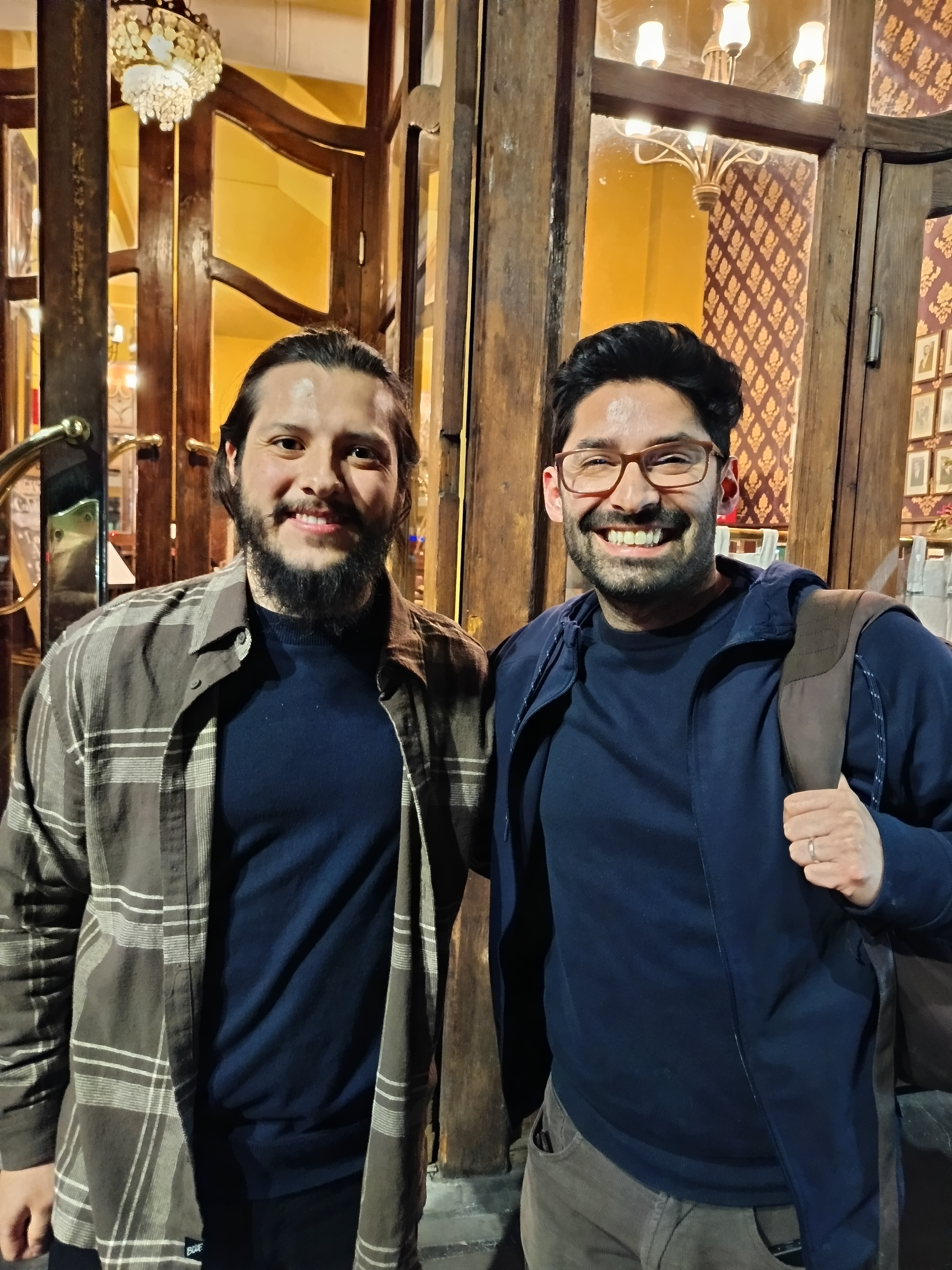
Matías Montero Salazar with his academic placement host, Diego Palacios, at the Society and Health Research Center (CISS), Universidad Mayor, Chile. Courtesy of Matías Montero Salazar (CC BY-NC 4.0).
Making Relationships Visible:
From Scattered Data to Social Networks
The hardest part of my placement was not fitting a very sophisticated statistical model. It was working out what the data meant before any model could be trusted.
I arrived at the Society and Health Research Centre (CISS) at Universidad Mayor in Chile to work with a two-wave dataset about peer relationships among 193 adolescents participating in eight extracurricular activity groups. Yet before we could examine how the networks had changed, we had to answer a series of less glamorous but essential questions. Was an adolescent absent from an activity or simply missing from one file? Did the same identifier refer to the same person across both time points? Which students had actually been able to nominate one another?
These questions mattered because adolescent relationships do not develop only inside classrooms. Young people also form friendships, reputations, and social hierarchies through orchestras, youth groups, scouting, and other extracurricular activities. These settings bring together cooperation, shared interests, performance, and sometimes competition. Studying them can therefore reveal aspects of adolescent social life that a formal, classroom-based research may overlook.
With support from the Grand Union Doctoral Training Partnership, I joined Diego Palacios to analyse this data from a wider Chilean project on friendship, peer groups, well-being, and socioemotional development. We designed a study focused on how adolescents’ relationships changed over time, particularly who came to be seen as popular and who was regarded as likeable as indicators of relational social status.
Knowledge exchange took place through the day-to-day process of solving the research problem together. In weekly meetings, Diego contributed his knowledge of the original project, the extracurricular groups, and longitudinal social network analysis (i.e., stochastic actor-oriented models). Our discussions connected methodological choices with the social processes represented in the data. In return, I contributed sustained analytical work, reproducible research practices, and experience in preparing complex relational data for network modelling.
A major outcome was the creation of a coherent and documented analytical workflow. I consolidated records stored across multiple files, verified participant identifiers, determined who was present at each time point, reconstructed the peer networks, and linked them to relevant student characteristics. I documented the decisions made throughout this process so that the research team can inspect, reproduce, and extend the analysis.
Once the data were ready, I estimated longitudinal network models to examine changes in popularity and likeability networks. We tested several approaches, including models that attempted to analyse multiple types of relationships simultaneously (multiplex networks!). Some of these models proved unstable. This became one of the most valuable methodological lessons of the placement: complexity is not evidence of quality. A simpler model is more useful when it clearly answers the research question and produces interpretable results.
My placement left CISS and the wider research team with cleaned and documented analytical materials, reproducible code, converged models, and completed sections for a jointly authored manuscript. Diego is now developing the remaining sections and leading the submission. We also plan to prepare a submission for the 2027 International Network for Social Network Analysis Sunbelt Conference in Montreal. It is really nice that the collaboration therefore continues beyond the formal end of the placement.
The benefits were equally important for my own development. I gained practical expertise in longitudinal network analysis, but I also became more confident in managing uncertainty, explaining analytical decisions, and reconsidering an approach when the evidence did not support it. These experiences are directly relevant to my PhD and to my longer-term ambition to build an academic career connecting sociological questions on education inequalities and social network models.
My advice to other doctoral students is to seek a placement centred on a genuinely shared problem. The strongest knowledge exchange does not happen when expertise travels in only one direction. It happens when the host’s knowledge and the student’s contribution are brought together to create something that neither could have produced in quite the same way alone.