
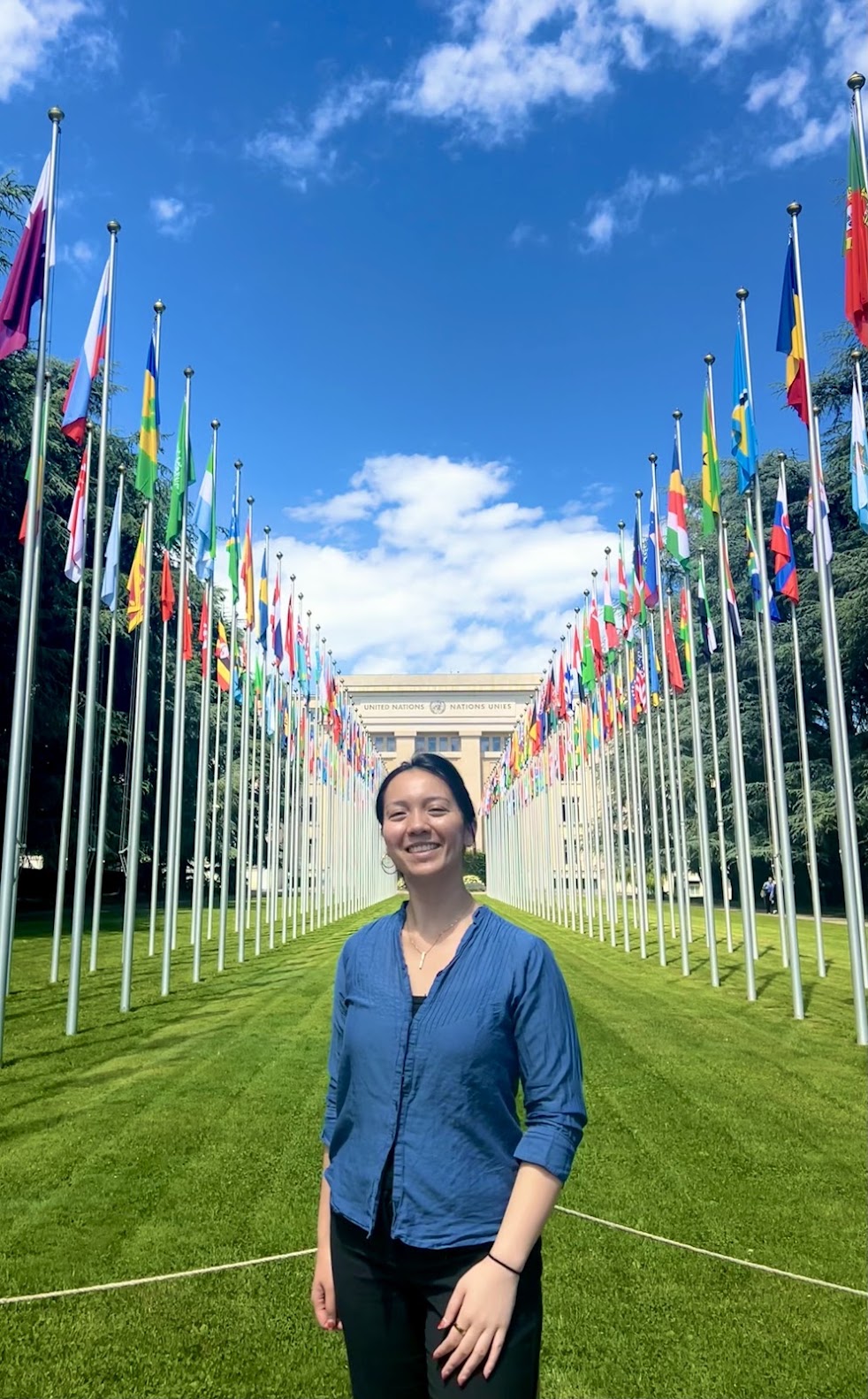
The author outside the Palais des Nations during the 114th Session of the International Labour Conference.
Courtesy of Jade Kosché.
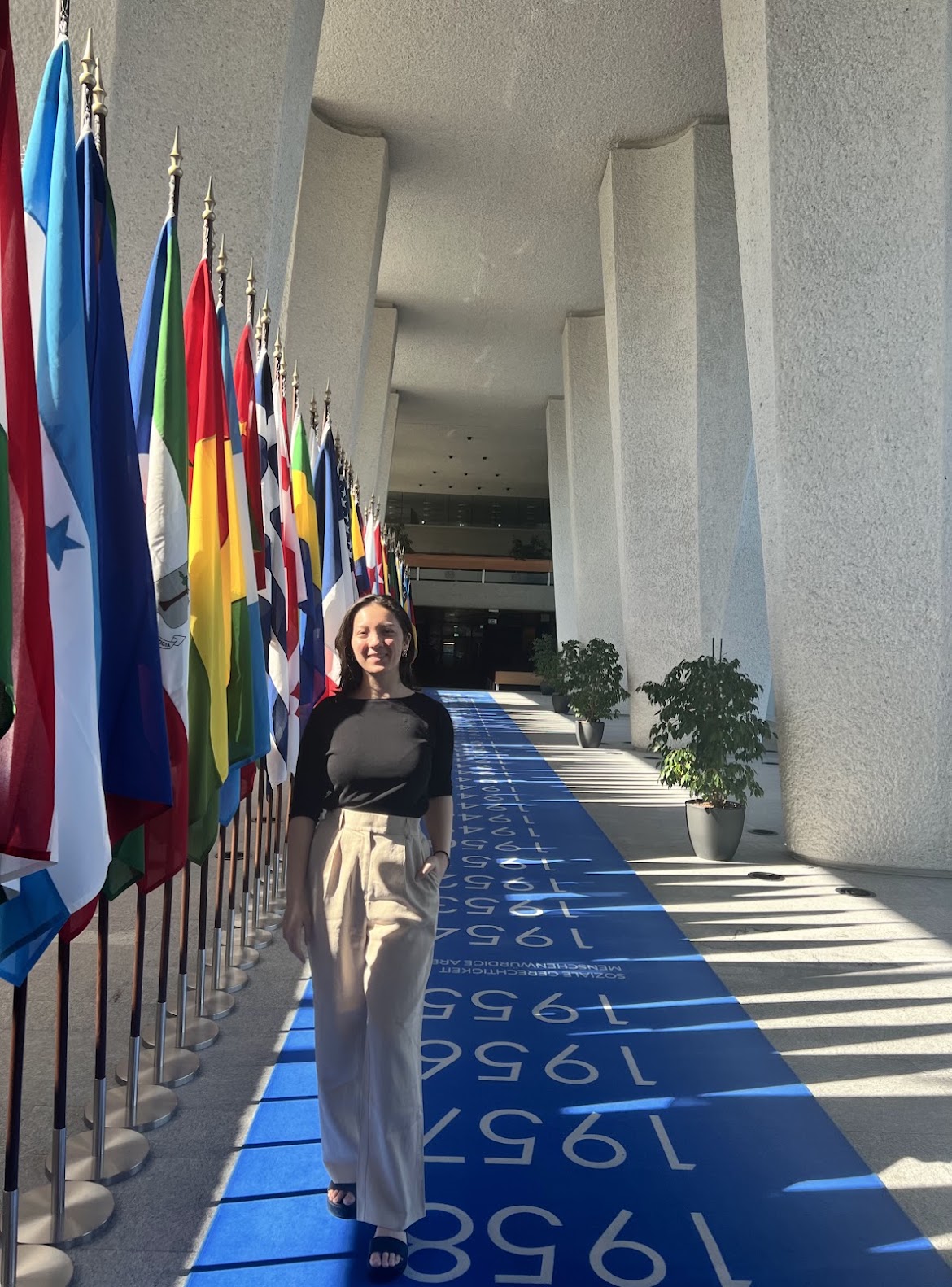
The author inside the International Labour Organization headquarters in Geneva.
Courtesy of Jade Kosché.
From Garments to Governance:
A Placement with the International Labour Organization
Every day, we rely on products made through global supply chains—from the clothes we wear to the food we eat and the electronics we use. Yet many of the workers behind these everyday items continue to face poor wages, unsafe workplaces and other labour rights challenges. While these issues exist across many industries, the garment sector has received particular attention over the past several decades, leading to the development of innovative approaches to improving working conditions.
One of the best-known examples is Better Work, a partnership between the International Labour Organization (ILO) and the International Finance Corporation (IFC). Operating in almost a dozen countries, Better Work brings together governments, employers, workers, and international brands to improve labour conditions in garment supply chains. As attention increasingly turns beyond garments to sectors such as agriculture, electronics, and fisheries, an important question has emerged: what lessons from Better Work might apply elsewhere?
An Independent Research Project at the ILO
This was the question I spent three months exploring during my time at the ILO headquarters in Geneva, where I worked as an ESRC-funded Independent Researcher with the Better Work and the Priority Action Programme on Decent Work in Supply Chains teams. Working alongside colleagues across the Organization allowed me to contribute to an ongoing policy research question while gaining first-hand insight into how international labour policy is developed.
During my time in Geneva, I explored the extent to which Better Work’s governance model—and the lessons learned since its inception over twenty years ago—might be adapted to other sectors. To investigate this, I conducted twenty-seven semi-structured interviews with specialists across the ILO, alongside documentary analysis of existing reports and background materials. I presented my preliminary findings to colleagues across the Organization before leaving Geneva and I am currently incorporating them into a discussion paper for the ILO.
Beyond my own research, I became embedded in the day-to-day activities of the ILO, attending weekly meetings, participating in cross-team discussions, and observing staff collaborate on shared policy challenges. My visit also coincided with the 114th Session of the International Labour Conference, where I observed the tripartite discussions underpinning international labour governance.
Knowledge Exchange in Practice
One of the most rewarding aspects of the research collaboration was the opportunity for genuine knowledge exchange. As a DPhil researcher in Socio-Legal Studies, I brought expertise in qualitative methods, legal and governance analysis, together with an independent academic perspective on a question that ILO personnel recognise as increasingly important. Equally valuable was working alongside experienced practitioners from across the ILO. Their insights continually challenged and strengthened my research, while our collaboration created the opportunity to examine a complex question in depth from both academic and practitioner perspectives.
The experience also transformed my understanding of how research informs international policy. Before working with the ILO, policy development often felt like something of a “black box”: I understood its outputs but not how evidence is gathered, debated, and translated into decision-making. Working collaboratively across teams, participating in programme discussions and observing the International Labour Conference gave me a first-hand appreciation of how research, social dialogue, and international cooperation come together to shape labour governance.
Impact and Looking Ahead
The discussion paper is currently undergoing revision and review and is intended to contribute to ongoing discussions about how labour governance approaches might be adapted across different sectors and supply chain contexts. For me, the collaboration highlighted the value of embedding doctoral researchers within international organisations, where research can directly inform real-world policy questions while benefiting both researchers and host organisations. As the first student from the University of Oxford to have a ESRC placement with the ILO, I also hope the experience helps strengthen the relationship between the two institutions and encourages future collaborations.
Reflections and Advice
For students considering a placement, my advice would be to embrace flexibility and recognise the value of your perspective. While stepping into a large international organisation can feel daunting, your role as an “outsider” is also one of your greatest strengths. Bringing a fresh perspective can make a meaningful contribution, while offering an invaluable opportunity to see how your research skills can inform policy on some of the world’s most pressing challenges.